Sony Refuses to Kill Sony Xperia and That's a Good Thing
Despite being a relatively unsuccessful player even in its home country, Japan, Sony — against all odds — continues to produce phones under its Xperia brand, despite its poor commercial performance compared to other brands like Sharp, Apple, and Google. What does the future hold for a brand that remains one of the top Android phone manufacturers, even today?
The fall of a giant
Far from withdrawing from the market as brands like BlackBerry and LG have already done after years of mediocre financial performance in a market as aggressively competitive as the smartphone market, Sony's Xperia — fortunately — is still resisting death.
Although Sony, through Xperia, has recently been producing excellent phones that ultimately satisfy needs that other phones fail to satisfy or do not satisfy at all, this has not helped Xperia to pose serious competition to brands such as Apple with its iPhone or Sharp with its Aquos, even in Japan and with the help of the prestige that "Sony" still retains as a brand. The excellent performance that Google's Pixels are exhibiting in the Japanese market doesn't seem to help, since it adds to the formula another strong competitor that Sony will have to face and that in 2023 was crowned as the third mobile manufacturer by market share in Japan, behind only Sharp and Apple.
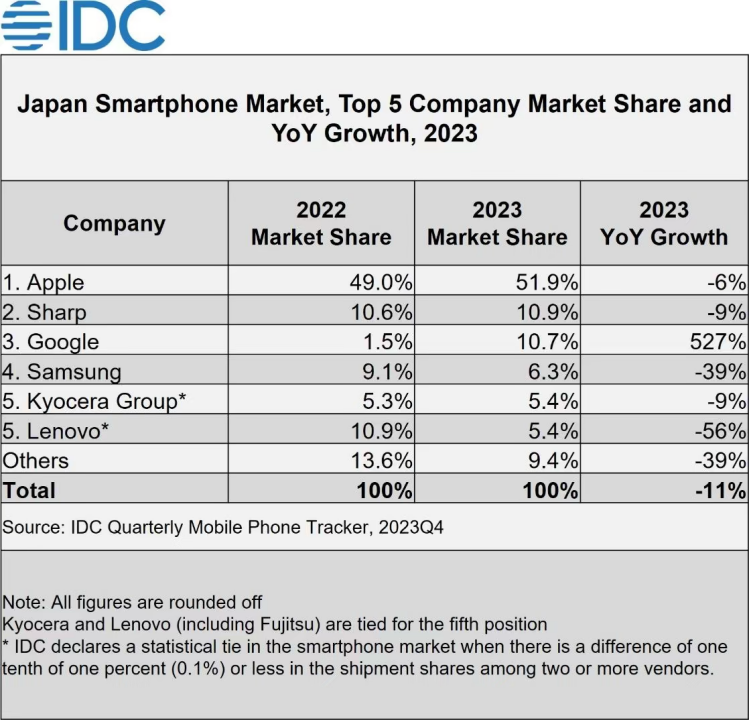
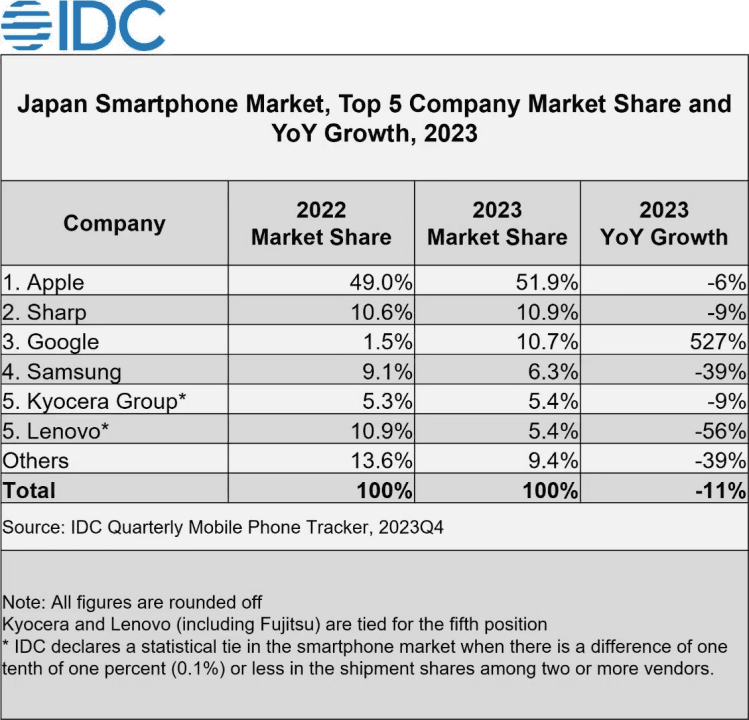
As evidenced in the previous chart, Sony is not even in the ranking, which suggests that it is not even the fifth-largest mobile phone seller in Japan, as one would expect from Sony. In a country of 125 million people, where people buy at least 30 million smartphones each year, this is especially alarming, and it gets worse when we hear that Sony has only sold 1 million phones.
The failure of Xperia
Following years of commercial difficulties within the joint venture between Sony and the Swedish telecommunications company Ericsson in 2012 — which gave rise to the Sony Ericsson brand — Sony found itself in a vulnerable position, which forced Sony to acquire Ericsson's 50% stake in the joint venture, Ericsson Mobile Communications AB, whose resolution would be announced on October 27, 2011, in which Sony would agree to pay €1.05 billion for the acquisition of 50% of Ericsson's shares in the aforementioned joint venture. Because access to wireless network-related patents was crucial and decisive for Sony, a cross-patent license was agreed upon, under which both companies could exchange the use of patents. On February 15, 2012, the transaction was completed, and Sony became the owner of the joint venture.
After this, Sony began to dedicate itself full-time to Xperia, which already existed since 2008. Xperia was born in response to the first-generation iPhone launched in 2007 by Apple — which forever redefined the way smartphones are conceived — and coexisted with Sony Ericsson, finding its place and reason for being in the premium mobile segment. Despite the fact that everything was in place for them to position themselves as one of the largest mobile phone manufacturers worldwide, and the loyalty to their brand that they already enjoyed with such legendary products as the Vaio or the Trinitron TVs, Xperia never achieved the success that the moribund HTC had in the market.
Much like LG's now defunct mobile phone division, Sony always went against the grain of what the industry was used to doing, and not necessarily for the worse. They popularized the "OmniBalance" design language within industrial design focused on mobile telephony, which stands out for its integration of aluminum or titanium bezels on the sides of the phone and glass on the back, giving the device a "premium" feel in the hand. For many years, they stood out for being the photographic smartphones par excellence, even above Samsung.
The Xperia Z series was excellently received. Previously, although phones with their own levels of protection already existed, the Z series introduced in 2013 popularized them. Starting with the Sony Xperia Z1, the first phone in the Z series, Sony standardized water and dust resistance on its phones, prompting the rest of the industry to follow suit. It was during these years that Sony reached its peak in terms of commercial performance, capturing between 3% and 5% of the global smartphone market, still behind Samsung and Apple, selling between 10 and 12 million units. In its native Japan, it consistently ranked between first and second in terms of smartphone sales for several years.
| Market share by smartphone manufacturers in Japan (2013) | |
|---|---|
| Manufacturer | Market share (%) |
| Apple | 36.6 |
| Sharp | 13.0 |
| Sony | 12.3 |
| Kyocera | 9.3 |
| Fujitsu | 8.6 |
| Others | 20.2 |
You may have noticed that Sharp, a largely under-the-radar mobile phone manufacturer, consistently ranks among the top picks, surpassing Sony, reflecting Sony's poor performance in recent years in the mobile phone market. It is true that, at least between 2013 and 2015, they remained relatively relevant, but we never saw a spectacular comeback that would place them among the top spots, neck and neck with the Chinese brands that were booming at that time, led by manufacturers such as Xiaomi, OnePlus, Huawei, and Oppo. After 2013, Sony did nothing but lose market share in the mobile phone market across all segments; from the premium range, which they intended to target, and which was already being dominated by Apple, to the mid-range, where Sony indisputably lost to Chinese brands.
Targeting a nearly non-existent market
After years of registering red numbers in its finances, Sony did not discontinue Xperia, but merged Sony Mobile Communications into Sony Corporation, the parent company, on April 21, 2021, and decided to implement a strategy change: focusing Xperia only on the niche market of content creators and multimedia. This strategy reflects Sony's commitment to preserving elements that, at least in the premium segment, have disappeared, such as the 3.5-millimeter headphone jack for analog audio and the microSD card slot. From that moment on, Sony began emphasizing the multimedia capabilities of its Xperia phones; such as the camera, screen, and speakers.
Have Sony's mobile phones managed to stand out in the three categories they are marketed in? Yes, totally. The latest heavyweight to date, the Sony Xperia 1 VI, released on June 3, 2024, has proven to be an excellent contender for the best Android phone of the year. In the review carried out by the GSMArena team on May 15, 2024, the incredible quality of its speakers is highlighted, which they described as "among the best stereo speakers we've heard on a phone.", part of the reason for its unusually thick bezels on the screen, which Sony explains is to accommodate very high-quality speakers, something that in the same review by GSMArena is described as "unorthodox", considering that it goes against the direction of companies such as Apple, which are betting on mobile phones with smaller borders and screen bezels.2
In addition to the above, we find what is possibly one of the premium-range mobile phones with the longest battery life in history, at least in its class, with an Active Use score of 17:27h. Besides, it has proven to be an incredibly capable photographic mobile phone, producing photos rich in detail, opting for natural colors, just as other pairs such as the Google Pixel 9 Pro XL do, producing generally superior photographs to those of other mobile phones such as the Samsung Galaxy S24 or S25 Ultra. All these features, which revolve around everything related to multimedia, are sold at €1,399.00 (in Europe), a very high price that only a select audience would be willing to pay.
It is difficult to know whether this commercial approach has effectively overcome the Xperia's marketability problems, as Sony does not publicly report sales of its phones in its financial reports, but it turns out that things are not going well for them at all, not even in Japan, where their sales continue to collapse. Despite Sony's generous strategy with its Xperia, it has seen more setbacks than progress, as it is targeting a market that is almost non-existent today: multimedia. Most people who need a mobile phone with powerful photography capabilities won't turn to Xperia, but will instead choose a high-end phone, particularly those from established brands like Samsung, Google, Xiaomi, or Apple. If we take a look at the ranking of mobile phones by photographic quality prepared by the French company DxOMark, we will observe that, precisely, among the first places are mobile phones such as the Google Pixel 9 Pro XL or the iPhone 16 Pro Max—two very common choices for those looking for mobile phones with the best camera. Ironically, Sony Xperia 1 VI does not appear in this ranking.
"We recognize that our mobile communications business is not only a handset business, but also a business with important communication technology that contributes to the entire Sony Group," a Sony spokeswoman told Bloomberg. "We believe that the communication technology we hone with smartphone technology is a necessary element to connect creators and customers and to provide entertainment regardless of time and place.", suggesting that Xperia exists as a bridge for integrating all the technology and ecosystem that Sony currently has, as well as providing a tool for content creators and professional users with special needs.3
Conclusion
As Marques Brownlee suggests in his review and analysis of what I consider to be one of the best Android phones currently, the Sony Xperia 1 VI launched on June 3, 2024, Sony should refocus its mobile phones on the lucrative and thriving mid-range sector and introduce a cross-subsidization strategy, which would financially sustain its niche and premium mobile segment with the revenue generated from sales of mid-range phones. Brownlee expresses concern based on the indisputable fact that Xperia is not performing well commercially, and how that could result in us losing a player, although not relevant, but definitely excellent as Xperia is, just as it happened at the time with LG, who, incidentally, was in a better position than Xperia is currently in when it left the smartphone market.
To carry out this refloating of the sunken Xperia, it will be necessary to allocate a significant amount of money to advertising them, on account that Sony never really advertised the Xperia as aggressively as brands like Samsung or Apple, which spend huge sums of money on advertising their phones. The mid-range may have aggressive competition, which immediately drives out potential new entrants, but Sony has an established image as a "high-quality brand" with an impeccable production chain, and given such an image, it might not be difficult to approach customers such as the younger audience, where the multimedia capabilities of an electronic device tend to be attractive, if this is how Sony seeks to promote its phones. Xperia has something to offer, and it would be a shame if they fell into the same fate as LG.
This article attempts to explain the Xperia debacle and the possible reasons and solutions to save it from dissolution. They have now lost America, from which they have decided to withdraw, and from which — in my opinion — they still have a place to claim in the mobile phone market, already dominated by Samsung, Apple and Google. As we have seen, in their home country, they are far from even the leading mobile phone manufacturer, even outperforming Sharp. This trend seems to have been ongoing for several years, since all they have done is lose market share to Google, another manufacturer that has joined the already strong competition from Sharp and Apple in Japan.
Xperia, despite trying to target a younger audience, its phones in Japan, according to certain estimates, tend to be marketed more to individuals between 40 and 50 years old, than to those in their 20s or 30s, where Apple dominates almost completely, at least in Japan. Sony has stopped publishing figures relating to the sales and finances of its mobile division in its financial reports, in part to avoid pressure from its investors to stop producing mobile phones in what is currently a loss-making division of Sony, a company that is now becoming irrelevant in everything that once propelled it to supremacy in consumer electronics. Vaio has already fallen, and Xperia could be next.